Ziyad verdict
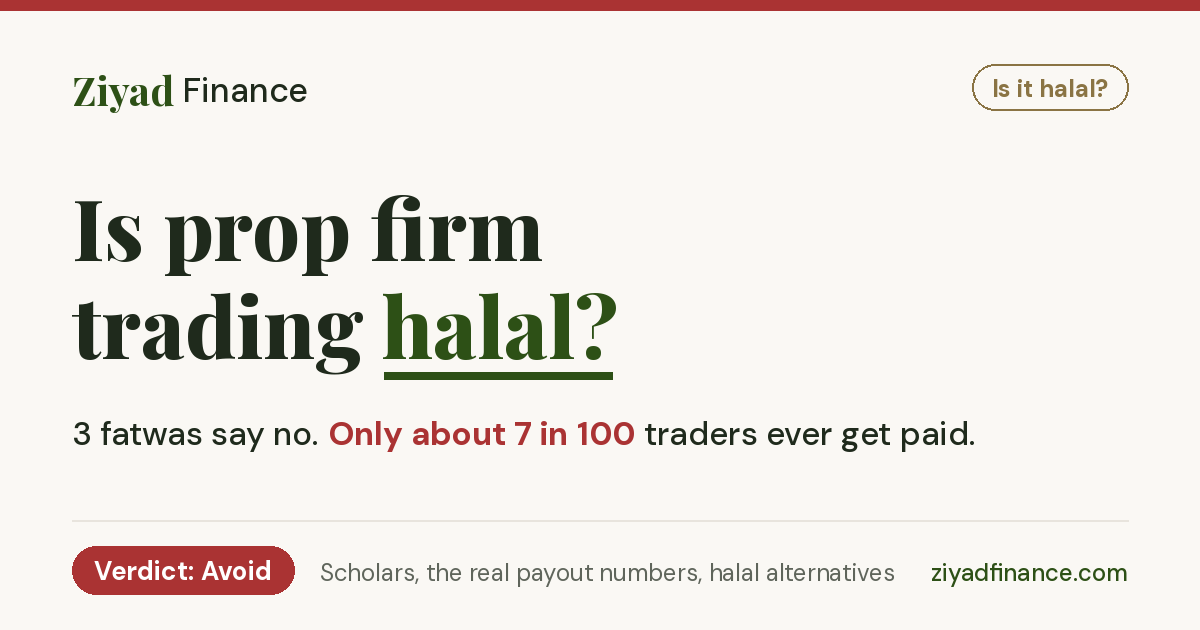
Three fatwa services say it's not permissible.
Darul Fiqh, Darul Ifta Birmingham and SeekersGuidance have each ruled against prop firm trading. Their reasons are the fee, the uncertain payout and the products being traded.
Use
- Islamic savings accounts
- Shariah index funds in an ISA
- Physical or fully allocated gold
Avoid
- Prop firm challenges and resets
- CFDs, including gold (XAUUSD)
- Leveraged and swap-free forex accounts
- Paid signal groups
Check
- The firm on the FCA Warning List
- Who earns from your sign-up
- A scholar you trust
Checked 28 November 2026 against published fatwas and regulator warnings. Our reading of mainstream scholarly views, not a fatwa.
You've probably seen one. A screenshot of a £4,000 payout. A certificate that says "£100,000 Funded Trader". A discount code in the caption that ends at midnight.
The pitch is simple. Pay a fee, pass a trading test, then trade a firm's money instead of your own. For a Muslim there's a second question after "does it work?" Is it halal?
I'm not a scholar, so you won't get a ruling from me. I've read what qualified scholars have published on prop firms, and the numbers the industry has released about itself. Every source is linked, so you can check it yourself.
Is prop firm trading halal? Part by part
| Part | The problem scholars raise | Verdict |
|---|---|---|
| The challenge fee | You pay for a payout that may never come, with no real asset or service in return | Avoid |
| The "funded" account | Often still a simulation, with trades the firm controls | Avoid |
| What you trade | CFDs, futures and leveraged forex. You never own anything | Avoid |
| A swap-free or "Islamic" account | Removes the overnight interest charge, nothing else | Doesn't fix it |
| The profit split | Comes from the activity above | Avoid |
Verdict: the published fatwas we found say prop firm trading is not permissible, and a demo account or a swap-free label doesn't change that.
How a prop firm challenge works
Proprietary trading is a real job. Banks and trading firms hire traders to trade the firm's own money, and pay them a salary. That isn't what's on your feed.
What's on your feed is a paid test. It usually works like this:
- You pay a fee for a "challenge", sized against a pretend account of, say, £100,000.
- You trade a demo account. You have to hit a profit target without breaking the loss limits.
- There's often a second round with similar rules.
- Pass, and you're "funded". With many firms, the funded account is still a simulation. Belgium's financial regulator warned that people in these schemes never place real trades, and that the firm controls the simulated trades.
- Make a profit, and you get a share of it.
- Fail at any point, and the fee is gone. You're usually offered a reset or a new challenge, for another fee.
Most of these firms trade CFDs, futures or leveraged forex. Hold on to that, because it matters a lot for the Shariah question.
How many prop firm traders actually get paid?
In April 2026 the trade publication Finance Magnates reported figures from inside the industry. They aren't flattering.
| The number | What it means | Where it comes from |
|---|---|---|
| 7% of people ever received a payout | Out of 100 people who pay, about 7 ever get paid anything | FPFX Tech data, 300,000+ accounts across 10 firms |
| Average withdrawal of about 4% of the account size | On a "£100,000 account", the average withdrawal works out at around £4,000 | Same data |
| 5% to 10% pass the challenge | Most people fail the test itself | The founder of The Funded Trader, a prop firm |
| About 1 in 5 funded accounts led to a payout | Passing still doesn't mean getting paid | Same |
| Average spend of $4,270 on challenges, with close to 60% down overall | People keep buying new challenges | A prop firm's survey of about 500 of its own clients |
| 74% to 89% of retail CFD accounts lose money | The products themselves lose money for most ordinary traders | EU regulator ESMA, from national regulators' data (2018) |
Picture 100 friends who each pay for a challenge. About 7 of them ever see a payout. The rest lose their fees, and plenty buy another go.
That's why the screenshots look the way they do. You only ever see the 7.
What scholars say about prop firms
Three established fatwa services have answered this question directly. Two are based in the UK.
| Source | Who they are | Date | Ruling |
|---|---|---|---|
| Darul Fiqh | UK fatwa service run by Mufti Faraz Adam, an Islamic finance specialist and founder of the Shariah advisory firm Amanah Advisors | 17 August 2024 | Not permissible |
| Darul Ifta Birmingham | UK fatwa institute founded in 2006, overseen by senior muftis of Darul Uloom Bury. Answer by Maulana Kawsar Ahmed, checked by Mufti Mohammed Tosir Miah | 27 April 2025 | Not permissible |
| SeekersGuidance | Online Islamic seminary founded in 2007 by Shaykh Faraz Rabbani. Answer by Mawlana Ilyas Patel, checked by Shaykh Faraz Rabbani | 7 June 2026 | Not permissible |
All three answer from the Hanafi school. The concerns they raise (uncertainty, gambling-like deals and interest-bearing products) are recognised across all four schools.
Why scholars say it's not permissible
1. The fee doesn't buy anything real. In Islamic law, money has to be swapped for something real: goods, or a recognised service. Darul Ifta Birmingham says the joining fee gives you no lawful value in return. SeekersGuidance calls it a fee for a service that isn't recognised.
2. You're paying for a chance. You hand over a fixed amount now for a payout that may never come. SeekersGuidance names this uncertainty as a reason in itself, citing the hadith that forbids deals built on uncertainty (gharar).
3. The products aren't accepted. CFDs, futures and leveraged forex are what most challenges trade. Mufti Faraz Adam's published answers treat online CFD trading, margin trading and retail forex as not Shariah compliant. A perfect score on a demo is still practice at trading them.
4. Your demo trades might not stay in the demo. Darul Fiqh raises the concern that firms may copy a trader's demo activity into real accounts. Italy's regulator, Consob, warned about exactly this in July 2024: prop firms may replicate traders' best virtual trades on real accounts, and the reports it received showed people who paid got no economic benefit from the firms (IOSCO alert). If your trades are copied, you're helping place trades in products scholars don't accept.
5. The payout carries the same problem. If the activity underneath is impermissible, these scholars say the profit share from it is too.
"But it's only a demo": the usual objections
If you send this to a friend who's already in, these are the replies you'll get.
"No real money is traded, so it's fine." The scholars above considered this. Darul Ifta Birmingham's ruling covers simulated accounts as well as real ones. SeekersGuidance looks at the deal itself: you pay a fee for a payout that may never come, with no real asset or service in return. Running it on a demo doesn't change that.
"I'm being paid for my skill, like a job." In a job, your employer pays you. Here you pay them first, and most people never get anything back. Darul Fiqh treats the fee as payment for a service, and says training to trade prohibited products isn't a service you can lawfully pay for.
"The firm gives me an Islamic, swap-free account." That removes one charge, and nothing else. Mufti Faraz Adam has said that having no swap fees doesn't on its own make a trading account Shariah compliant (IFG forum, July 2020). The fee, the uncertainty and the products are all still there.
"Trading is halal, so this is too." Owning shares in screened companies is widely accepted by scholars. A challenge isn't that. It's a paid test on a simulated account, trading products these scholars don't accept.
"Loads of Muslims do it." That tells you it's popular, not that it's permissible. If you're unsure, take the firm's terms to a scholar you trust and ask them directly.
Who makes money from prop firms
If only about 7 in 100 traders ever get paid, it's worth asking who gets paid every time. Usually it's the people selling the way in.
- Discount codes. A code in a caption usually means the person posting earns a commission when you sign up, whether you pass or not.
- Courses and mentorships. In March 2024 Belgium's regulator warned about a rise in prop firm adverts on social media, and in websites selling paid courses to help people pass the challenges. It said many people keep paying for courses without ever reaching real trading.
- Signal groups and copy trading. In October 2025 the UK's FCA warned that finfluencers may push unregulated offshore firms without making that clear, and that some promise unrealistic returns from copy trading or paid daily tips. It said over 90,000 people lost around £75m over four years through one firm.
None of this means everyone posting about trading is dishonest. It means that when someone earns from you joining, their advice isn't neutral. That's true of any product, including the ones on this site, which is why our affiliate links are always disclosed.
Are prop firms regulated in the UK?
I couldn't find an FCA statement aimed specifically at prop firm challenges as of November 2026. The FCA has been clear about the products and the people promoting them. It calls CFDs "complex, high-risk products", has restricted their sale to ordinary investors since 2019, and in June 2025 led an international crackdown on illegal finfluencers that led to 3 arrests (FCA, October 2025).
Regulators elsewhere have gone further:
| Regulator | When | What they said |
|---|---|---|
| FSMA, Belgium | March 2024 | Urged "extreme caution". People pay for costly courses, trade only on demo accounts and never place real trades (report) |
| Consob, Italy | July 2024 | Warned about "funded trading", also known as a "shadow investment game" (IOSCO alert), and compared these schemes to video games |
| Spain, Germany, ESMA (EU), ASIC (Australia) | 2024 to 2026 | Raised similar concerns. ASIC warned influencers promoting prop firms without risk warnings (report) |
Before paying any trading firm anything, search its name on the FCA Warning List.
Prop firm red flags
Prop firm, forex course or signals group, the warning signs are the same:
- A countdown, a discount code or "only 10 spots left"
- Payout screenshots and certificates as the main proof
- "Fee refunded with your first payout"
- Cheap resets so you can go again straight away
- A course, mentorship or Telegram group sold alongside
- "Islamic account" or "swap-free" offered as proof it's halal
- No UK authorisation, and a company address overseas
- Talk of steady monthly income or quitting your job
Halal alternatives to prop firm trading
Most people who try prop firms want the same thing: more money, without a big pot to start with. That's a fair thing to want. There just isn't a halal shortcut to it. These are the slower routes that scholars broadly accept.
1. Build a cash buffer that earns a halal return. Islamic savings accounts pay an expected profit rate instead of interest. The bank invests your money in Shariah-compliant assets, and the rate is indicative, so it can change. UK Islamic banks are authorised like any other bank, and since 1 December 2025 eligible deposits have been protected by the FSCS up to £120,000 per person, per bank (banks that share a banking licence count as one). Compare Islamic savings rates.
2. Own part of real companies, and hold for years. This is the opposite of a prop challenge. When you buy a share, you own a small piece of an actual business: a supermarket, a drug maker, a software company. You share in its profits through dividends and in its growth over time. Nobody gets paid because you failed a test.
For most people the simplest way in is a Shariah index fund inside a stocks and shares ISA. One fund holds many screened companies at once, and the screening removes banks, alcohol, gambling and companies carrying too much interest-bearing debt. Mufti Faraz Adam's reviewed guidance explains why standard index funds usually fail and how Shariah index funds differ. Our halal investing guide compares the funds and platforms.
The value of investments can fall as well as rise, and you may get back less than you put in. Think in years, not weeks.
3. If you love markets, learn them through real ownership. SeekersGuidance's answer points people who want to trade towards spot trading of assets you actually own, and Shariah-screened shares. Scholars are still cautious about fast day trading, even in screened shares, so ask before you go further.
4. Talk it through. If you've already spent money on challenges or courses and want to reset, book a one-to-one call. 10% of every fee goes to the National Waqf Fund.
Frequently asked questions
Is prop firm trading halal if it's only a demo account?
Darul Fiqh, Darul Ifta Birmingham and SeekersGuidance all say no. Their concerns are the fee, the uncertainty and the products involved, and a demo account doesn't remove any of them.
Is FTMO halal?
No fatwa I found names a specific firm. The rulings above cover the challenge model, and FTMO's own FAQ describes exactly that: every account it provides has fully fictitious funds, its traders never trade on live markets, and FTMO may use their trading data for its own real trades (FTMO FAQ). If you're weighing any named firm, take its terms to a scholar you trust.
Is a swap-free or Islamic trading account halal?
Not on its own. It removes the overnight interest charge, but you still don't own what you're trading, and with a prop firm the fee and payout problems remain. Mufti Faraz Adam has said no swap fees doesn't by itself make an account Shariah compliant.
What if I only trade gold, with no leverage?
It's still a problem, and gold actually makes the rules stricter. On a prop firm or trading app, "gold" (XAUUSD) is almost always a CFD. You never own any gold. You just hold a position on its price. In Islamic law, swapping gold for money has to happen on the spot, with both sides handed over before the deal ends, either physically or through specific, allocated bars in your name. Mufti Faraz Adam names gold and currency as the cases where possession is required, and SeekersGuidance rules online gold trading impermissible "even in the absence of leverage and interest" (answer). No leverage removes the loan, but it doesn't give you the gold. Going short is worse again: you're selling gold you don't own, which a hadith forbids directly. If you want gold, buy physical gold or a fully allocated, physically backed product.
Is forex trading halal?
Exchanging one currency for another can be permissible when real currencies actually change hands. Mufti Faraz Adam's view is that most retail forex platforms, where you speculate without ever taking delivery, are not Shariah compliant.
Is day trading halal?
Scholars differ, and many senior scholars advise against it. A common concern is selling shares before the purchase has settled and you fully own them. Holding Shariah-screened shares for the long term is the widely accepted route.
Are prop firms regulated by the FCA?
I couldn't find FCA rules written specifically for prop firm challenges as of November 2026. Check any firm's name on the FCA Warning List before paying anything.
I've already made money from a prop firm. What should I do?
That depends on your situation, so ask a qualified scholar directly rather than relying on an article.
Bottom line
Prop firm challenges are sold as a shortcut to trading big money. The industry's own data says about 7 in 100 people ever get paid, and the three fatwa services that have ruled on them say they're not permissible. The halal routes are slower and less exciting: a cash buffer earning an expected profit rate, and real shares held for years. If a friend is already in, send them this.
Sources, checked 28 November 2026: Darul Fiqh, Is prop firm trading halal? (17 August 2024) and Is possession necessary at the time of the transaction?; Darul Ifta Birmingham, fatwa 07997 on prop firm trading (27 April 2025); SeekersGuidance, Is Trading With Prop Firms Halal? (7 June 2026) and Is Online Gold Trading Without Leverage and Interest Permissible? (1 November 2024); Finance Magnates (7 March 2024 and 21 April 2026); IOSCO I-SCAN alert from Consob (15 July 2024); ESMA, additional information on CFD product intervention measures (27 March 2018); FTMO FAQ, How does an FTMO Account work from the technical side?; FCA press release on CFDs and finfluencers (30 October 2025); FSCS deposit protection page.
Ziyad Finance provides educational guidance only. This article summarises scholars' published views and is not a fatwa or religious ruling; ask a qualified scholar about your own situation. We are not financial advisers and we don't recommend products. Ziyad Finance earns a commission from some partners featured on other pages of this site, such as our savings comparison. This never changes the rate or terms you get. Expected profit rates are indicative and can change. Investments can fall as well as rise and you may get back less than you put in.