Is a stocks and shares ISA halal? The ISA is a tax wrapper, so it is halal if what you hold inside it is Shariah-screened. A cash ISA from a conventional bank is not, because it pays interest.
Quick answer: A halal stocks and shares ISA is a UK tax-free investment account that holds only Shariah-compliant assets, screening out conventional banks, alcohol, gambling, weapons and interest-bearing debt. The simplest 2026 setup is a Wahed ISA (fully managed) or a Trading 212 ISA holding Shariah-screened ETFs such as ISWD, ISUS or ISDE. You can open one online in under 20 minutes, start from as little as £50, and all growth inside the ISA wrapper is tax-free up to your £20,000 annual allowance.
Most UK Muslims sit in one of two positions. Either they have avoided investing entirely because they are unsure what counts as halal. Or they are already invested in something they have never properly checked. Both cost money over time.
Leaving everything in a 0% current account is not a neutral choice. UK inflation has averaged 3 to 4% over recent years, which means cash sitting idle loses real value every single year. And investing without checking compliance means you may unknowingly be earning returns that include interest income from banks, revenue from alcohol companies, or profits from weapons manufacturers.
The good news is that halal investing in the UK in 2026 is simple. You can open a Shariah-compliant stocks and shares ISA, buy a globally diversified halal ETF, and be fully invested in under 20 minutes. No financial adviser required. You can start with £50.
This guide covers everything you need to know: the screening rules, every major halal ETF available in the UK, reviews of Wahed and Trading 212, how to use your ISA allowance, and a step-by-step starting plan.
Important: This article is educational. Nothing here is personalised financial advice. All investments carry risk and you may get back less than you put in. If you are unsure what is right for your circumstances, speak to a qualified financial adviser.
What Makes an Investment Halal?
Shariah-compliant investing uses two filters. The first removes companies based on what they do. The second removes companies based on how they are financially structured.
The industry screen: what gets excluded
A company is excluded if more than 5% of its revenue comes from any of the following:
- Conventional banking and interest-based lending
- Alcohol production or distribution
- Tobacco
- Gambling and gaming
- Weapons and defence
- Pornography and adult entertainment
- Pork products
The financial screen: debt and interest exposure
Even companies in perfectly permissible industries can fail on their financial structure. The widely used AAOIFI standard (Accounting and Auditing Organisation for Islamic Financial Institutions) sets three thresholds:
- Interest-bearing debt below 30% of market capitalisation
- Interest income below 5% of total revenue
- Interest-generating cash and deposits below 33% of total assets
Why you should not try to screen stocks yourself
Running these checks manually across hundreds of companies is not realistic. This is the exact problem Shariah-compliant ETFs solve. They do the screening, the quarterly rebalancing, and the compliance monitoring. Your job is to pick the right one and invest consistently.
Halal ETFs Available to UK Investors
Exchange-traded funds are the most practical way for most people to invest in a halal portfolio. Each ETF holds a basket of pre-screened companies, trades on the London Stock Exchange like an ordinary share, and qualifies for both your stocks and shares ISA and your SIPP.
| ETF | Ticker | Market Focus | Annual Fee (TER) | AUM | Approx. 1yr Return* |
|---|---|---|---|---|---|
| iShares MSCI World Islamic UCITS ETF | ISWD | Global developed markets | 0.30% | £565M | 11.49% |
| iShares MSCI USA Islamic UCITS ETF | ISUS | US Shariah equities | 0.30% | £184M | ~13% |
| iShares MSCI EM Islamic UCITS ETF | ISDE | Emerging markets | 0.35% | £229M | 5.39% |
| Invesco Dow Jones Islamic Global UCITS ETF | IGDA | Global developed markets | 0.40% | $968M | Competitive |
| HSBC MSCI World Islamic Screened UCITS ETF | HIWS | Global developed markets | 0.30% | £48M | Similar to ISWD |
Every ETF on this list is UCITS-compliant. This matters for UK investors specifically because UCITS status is what makes a fund eligible for your ISA and SIPP wrappers. Without it, you lose the tax-free shelter.
Which one should you buy?
For most people starting out: ISWD.
ISWD gives you exposure to hundreds of Shariah-compliant companies across the US, Europe, Japan, Australia and Canada in a single purchase. The annual fee is 0.30%, which on a £10,000 portfolio works out to £30 per year. It has £565M in assets under management, meaning there is always liquidity when you want to buy or sell.
For US-focused exposure: ISUS.
ISUS holds only Shariah-compliant US companies. US tech dominates the holdings, which has produced slightly stronger returns than ISWD over the past year. Higher concentration brings higher potential return and higher short-term volatility.
For an alternative to iShares: IGDA.
IGDA from Invesco tracks the Dow Jones Islamic Market Developed index rather than the MSCI methodology. If you want to spread across two providers or methodologies, pairing ISWD with IGDA is a reasonable approach.
What about SPUS and HLAL?
You will see both mentioned in US-focused halal finance content. Both have strong long-term track records. SPUS has outperformed the conventional S&P 500 since its 2019 launch. The problem for UK investors: both are listed on US exchanges, priced in US dollars, and are not eligible for a UK ISA or SIPP. You take on currency risk and lose the tax-free wrapper. Stick with the UCITS options above.
The HSBC Islamic Global Equity Index Fund
For the full breakdown of holdings, charges by share class and where to buy it, see our HSBC Islamic Global Equity Index Fund review.
Separate from the ETFs, this mutual fund is worth knowing about. It is one of the longest-running Shariah-compliant equity funds in the UK and is used as the default halal option in many workplace pension schemes including NEST. It returned 11.83% over the past year and is available on most major UK platforms including Hargreaves Lansdown and AJ Bell.
Wahed Invest Review
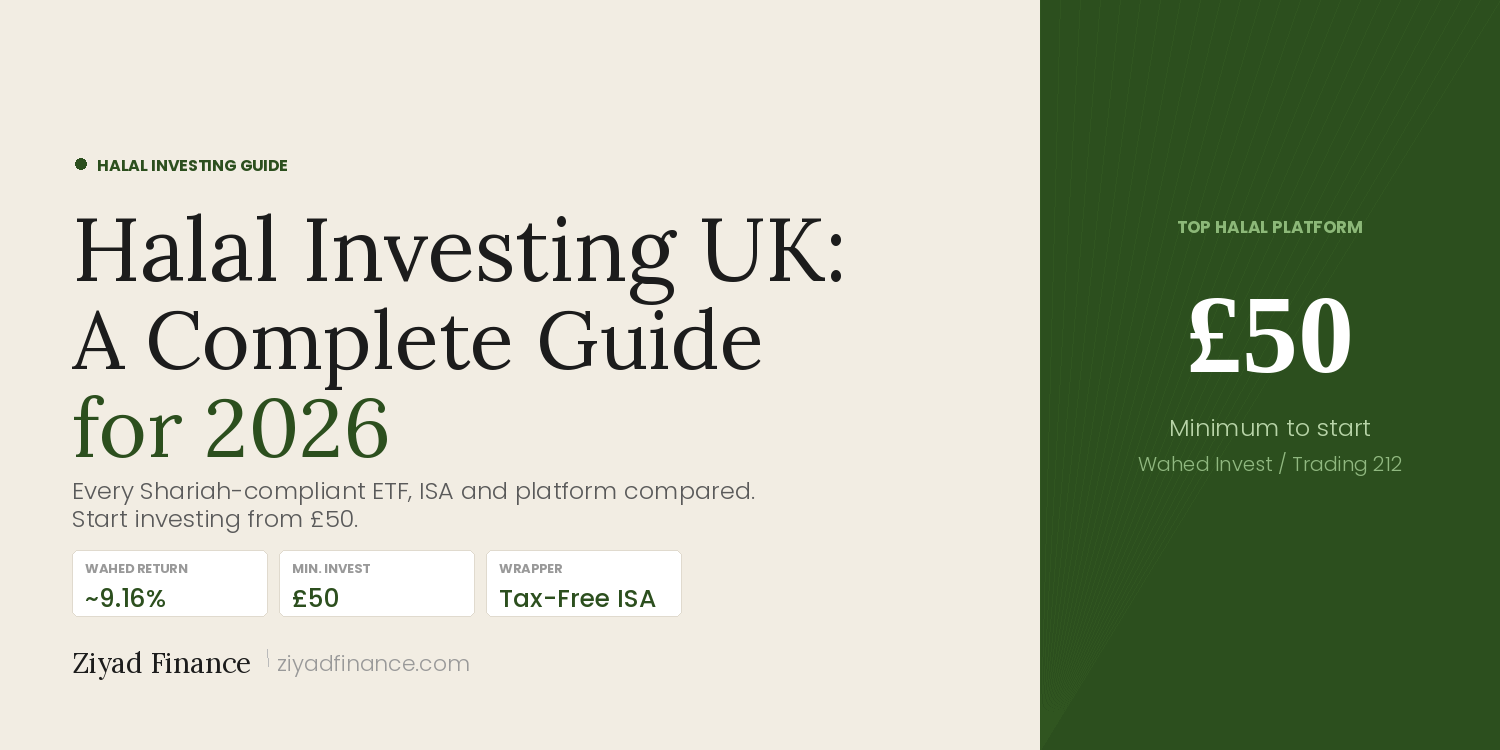
Wahed is the best-known halal investment platform in the UK. Founded in 2015, FCA-regulated, backed by $82M in funding, available in 55 countries. The UK product offers a fully managed halal portfolio with ISA and SIPP wrappers.
How it works: You answer a short risk questionnaire. Wahed builds a portfolio of Shariah-compliant assets at the appropriate risk level. Every holding is reviewed by a dedicated Ethical Review Board certified under AAOIFI standards.
Minimum investment: £50
ISA: Yes. SIPP: Yes.
Indicative portfolio returns:
| Portfolio | Holdings | Approx. 1yr Return* |
|---|---|---|
| Very Conservative | Primarily sukuk and gold | Low single digits |
| Moderately Conservative | Mixed sukuk and equities | ~4.76% |
| Moderately Aggressive | Equity-leaning | ~7-9% |
| Very Aggressive | Predominantly equities (HLAL, UMMA) | ~9.16% |
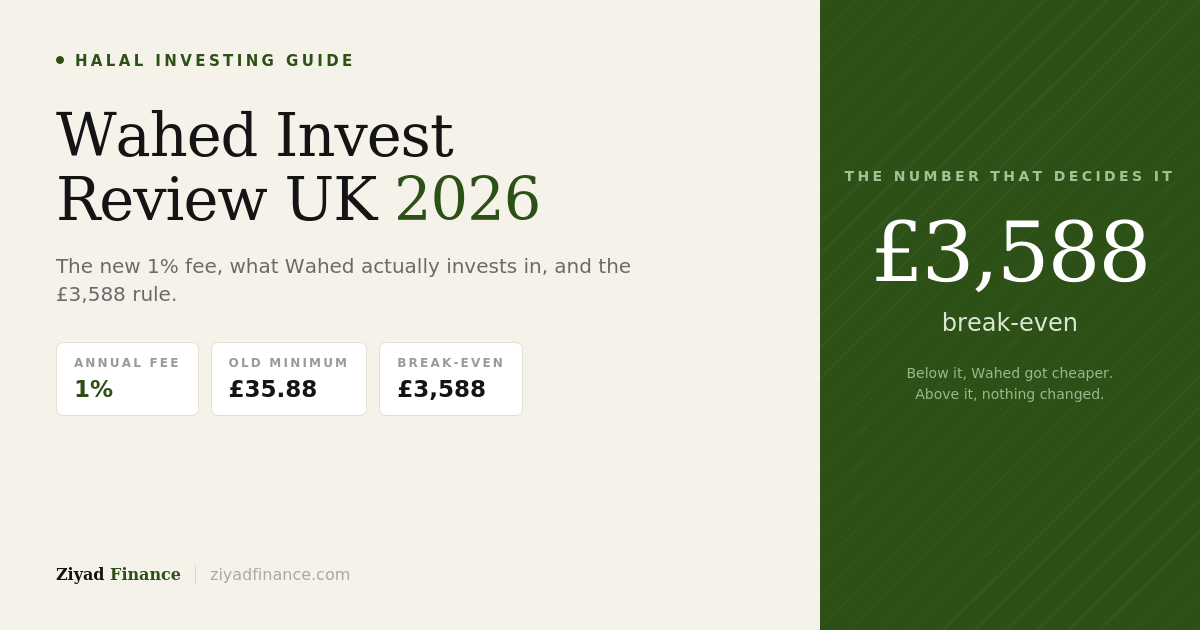
Fees: Wahed revised its fee structure in 2024. The fee as a percentage of your portfolio is relatively high for smaller amounts. The more you invest, the more cost-effective it becomes. Check the current fee schedule on their website before committing, and see our full Wahed Invest review for the break-even point.
What works well: The compliance is rigorous and independently certified. You do not need to make any investment decisions yourself. Set up a monthly payment and leave it. For someone who wants a fully managed, fully compliant solution with minimal time input, Wahed does exactly what it says.
What to watch: Customer service has been slow based on a pattern of Trustpilot reviews from 2024 and 2025. Several users reported difficulty accessing funds or getting timely responses when issues arose. This is worth knowing before you put significant money in. Cost is the other consideration. A hands-on investor can replicate similar exposure by buying ISWD on Trading 212 for considerably less in annual fees.
Verdict: suits beginners who want a fully managed, compliant solution. If you are comfortable managing your own investments, you will save on fees by going direct.
Start with £50. Wahed adds £10.
Want it fully managed? Enter code ziyad when you sign up in the Wahed app. Shariah-screened portfolios, picked and rebalanced for you, inside a Stocks and Shares ISA if you want one. Add the code before you finish sign-up, because it can't be added later. Capital at risk.
£10 paid once a qualifying account is funded with at least £50. A Stocks and Shares ISA qualifies. Terms set by Wahed and can change. Ziyad Finance is a Wahed partner and may benefit when you use the code. Investments can fall as well as rise and you may get back less than you put in.
Is Trading 212 Halal?
Trading 212 is not a Shariah-certified platform. There is no dedicated Islamic account, no Shariah board, and no built-in compliance checking. However, it can be used in a completely halal way if you follow these steps properly. Our full Trading 212 guide goes through each account type.
Step 1: Open the Stocks and Shares ISA, not the Invest or CFD account.
The CFD account uses borrowed money and allows short-selling. Both are impermissible under Islamic finance principles. The Invest account lends your shares to short sellers by default and pays you interest on them. The Stocks and Shares ISA does neither, because ISA rules do not allow share lending. When signing up, select the Stocks and Shares ISA.
Step 2: Turn off interest on uninvested cash.
By default, Trading 212 pays interest on cash sitting in your account. This is riba. Go to Settings as soon as your account is open and disable it. It takes 30 seconds and you will not miss the function.
Step 3: Buy only Shariah-screened ETFs.
ISWD, ISUS, ISDE, IGDA and HIWS are all available on Trading 212. These are the pre-screened funds covered above. If you ever want to buy individual stocks rather than ETFs, verify each one through a screening tool like Zoya or Islamicly before purchasing.
Step 4: Never touch the CFD side.
No borrowed money, no short-selling, no CFDs, no margin. The ISA makes it easy to avoid all of this if you use it as intended.
What Trading 212 does well: Commission-free buying. Stocks and shares ISA included at no extra cost. Fractional shares available, so you can invest any amount regardless of the share price. You can start with £1.
The trade-off: The compliance responsibility sits entirely with you. Trading 212 will not flag a non-compliant stock or warn you about interest settings. You have to set it up correctly and maintain that discipline.
Verdict: the lowest-cost way to halal invest in the UK, once configured correctly. Better suited to someone who is comfortable making their own fund selections.
Open a Trading 212 account and get a free share
How to Use a Halal Stocks and Shares ISA
Halal ISA vs Ethical ISA: What's the Difference?
The two terms sound similar but mean different things. An ethical ISA typically uses ESG (Environmental, Social, Governance) screens. It might exclude tobacco and weapons, but will often still hold conventional banks, insurance companies and businesses with significant interest-based debt. There is no Shariah board reviewing the holdings.
A halal ISA applies Shariah screens. That means no conventional banks, no insurance companies, no alcohol, gambling, tobacco, weapons or pornography, and a strict cap on companies with excessive interest-bearing debt or interest income. Each fund is overseen by a Shariah supervisory board and any incidental impure income must be purified through charity.
If avoiding riba matters to you, an ethical ISA is not enough. You need a Shariah-screened product. Wahed and Shariah-screened ETFs such as ISWD, ISUS and ISDE all qualify.
Every UK resident over 18 receives a £20,000 ISA allowance each tax year. Investments held inside an ISA grow completely free of capital gains tax and income tax. The allowance resets every April. What you do not use in one year is gone.
Both Wahed and Trading 212 offer stocks and shares ISAs at no additional charge. The ISA is simply a tax-free wrapper around the same investments. Open the ISA version of your account rather than a general investment account.
A few rules worth knowing. You can only pay into one stocks and shares ISA in any single tax year. The £20,000 is per person, not per account. Old ISAs from previous years can be transferred to a new provider without losing their tax-free status. The transfer does not count against your current year allowance.
Using an ISA from the start is not optional for serious long-term investing. The tax saving compounds alongside your returns and becomes very significant over 10 to 20 years.
What Consistent Investing Actually Produces
The biggest mistake UK Muslim investors make is not choosing the wrong fund. It is not starting.
Every year of delay has a real financial cost. The table below shows what a monthly investment in a halal equity fund averaging 8% annual growth produces over time. Eight percent is an assumption for illustration, not a forecast.
| Monthly Investment | After 5 Years | After 10 Years | After 20 Years | After 30 Years |
|---|---|---|---|---|
| £50/month | £3,698 | £9,147 | £29,451 | £74,518 |
| £100/month | £7,397 | £18,295 | £58,902 | £149,036 |
| £200/month | £14,794 | £36,589 | £117,804 | £298,072 |
| £300/month | £22,191 | £54,884 | £176,706 | £447,108 |
| £500/month | £36,985 | £91,473 | £294,510 | £745,180 |
The most important comparison in that table is not between the £100 and £500 rows. It is the cost of waiting.
Someone who starts investing £100 a month at age 25 has £149,036 at 55. Someone who waits until 35 and invests the same amount has £58,902 at the same age. The ten-year delay cost them £90,134. Not because of any market difference. Because of time.
Start with whatever you can afford. Increase it as your income grows. The amount matters far less than the habit.
How to Start: A Practical Step-by-Step Plan
Step 1: Sort your emergency fund before anything else
Before putting a single pound into investments, you need 3 to 6 months of essential expenses in a halal easy-access savings account. Islamic easy access accounts are FSCS protected up to £120,000. They pay less than fixed terms (around 2.7% at Al Rayan and Gatehouse in mid-September 2026), so check the current rates before you choose.
This is not optional. Markets can fall 30 to 40% in a bad year. If you invest without a cash reserve and then face an unexpected expense, you may be forced to sell at the worst possible time. See our full comparison here: Best Halal Savings Accounts UK.
Step 2: Choose your approach
There are two practical options for UK halal investors.
Option A: Wahed. Complete a questionnaire, choose your risk level, set up a monthly payment. Wahed manages everything. Minimum £50. Higher fees than DIY but zero time input required. Ideal if you want a hands-off, fully certified solution.
Option B: Trading 212 with ISWD. Open a Stocks and Shares ISA, disable interest, set up a monthly purchase of ISWD. Commission-free. Lowest cost available. Requires about 20 minutes of setup and occasional checking.
Step 3: Open your ISA, not a general account
Whichever platform you choose, open the stocks and shares ISA. It costs nothing extra and the tax-free status matters significantly over any investing horizon longer than a few years.
Step 4: Pick your fund
If you are going the DIY route, ISWD is the right starting point for most people. One fund, globally diversified, Shariah-certified, 0.30% annual fee, fully ISA and SIPP eligible. You do not need multiple ETFs when you are starting out. One solid global fund is enough.
Step 5: Automate the monthly purchase
Both platforms support automated monthly contributions. Set an amount that leaves your finances comfortable and automate it. Removing the decision removes the temptation to delay, pause, or time the market.
Step 6: Check it quarterly, then leave it alone
Look at your portfolio once every three months. That is it. Short-term market movements are noise. Investors who check daily tend to make worse decisions than those who check quarterly. The long-term trajectory of globally diversified equity markets is what matters and it is not something you can influence by monitoring more frequently.
What About Halal Pensions?
Around a third of UK Muslims do not have a workplace pension. The main reason given is Shariah compliance uncertainty. This is one of the most costly financial decisions a UK Muslim can make.
A workplace pension in the UK includes compulsory employer contributions of at least 3% of your qualifying salary, on top of your own contributions. Not participating means leaving that money entirely. It is an immediate boost to your own contributions that you give up by opting out.
Halal options exist across the pension market. NEST, the government workplace pension scheme, includes a dedicated Shariah-compliant fund (see our Nest Sharia Fund review). The HSBC Islamic Global Equity Index Fund is available as an investment choice within SIPP accounts at Hargreaves Lansdown, AJ Bell and others. Wahed also offers a self-invested personal pension with Shariah-compliant portfolios.
If your workplace scheme does not currently offer a halal fund option, you can formally request one. Nest already offers a Sharia fund to its members. Other providers vary but many will accommodate the request.
Our halal pension guide covers how to check your fund and switch. If you want to talk it through, book a 1-to-1 call.
Platform Comparison
| Platform | Type | Minimum | ISA | SIPP | Shariah Certified | Best For |
|---|---|---|---|---|---|---|
| Wahed Invest | Managed | £50 | Yes | Yes | Yes (AAOIFI) | Hands-off beginners |
| Trading 212 | DIY broker | £1 | Yes | No | No (self-managed) | Fee-conscious, DIY |
| Hargreaves Lansdown | DIY broker | £1 | Yes | Yes | No (self-managed) | Larger portfolios, fund range |
| AJ Bell | DIY broker | £1 | Yes | Yes | No (self-managed) | ETF and fund investors |
| Cur8 Capital | Specialist | £5,000 | No | No | Yes | Higher net worth, alternatives |
Common Mistakes
Thinking ESG means halal. It does not. ESG (Environmental, Social, Governance) funds use completely different criteria to Shariah screening. Many ESG funds hold major conventional banks. A fund labelled ethical or sustainable is not Shariah-compliant unless it is explicitly Shariah-certified.
Opening the Trading 212 CFD account by mistake. The CFD account uses borrowed money and short positions. It is a different product to the Stocks and Shares ISA. Choose the ISA when signing up and never switch.
Forgetting to disable interest in Trading 212. It is on by default. Open Settings on day one and turn it off. This is the most common oversight for Trading 212 users.
Not wrapping investments in an ISA. There is no good reason to hold investments in a general account before filling your ISA allowance. The tax saving on gains and dividends is real and grows with your portfolio.
Skipping income purification. Shariah-compliant ETFs do earn a small amount of non-compliant income each year, usually well under 1% of total returns. This happens because no company is perfectly compliant in every single transaction. Calculate the purification amount using the ratio published by the ETF provider and donate it to charity. This is standard practice for any halal investor holding these funds. It is not a reason to avoid them.
Investing before the emergency fund is ready. If markets fall and you need cash, you will sell at a loss. Build the cash buffer first.
Frequently Asked Questions
Is investing in the stock market halal?
Yes, provided the right screening is applied. Owning shares means owning a proportional stake in a business and participating in its profits and losses. This is a permissible form of investment under Islamic law. What is not permissible is holding shares in companies whose core activity involves riba, gambling, alcohol, or other prohibited sectors. Shariah-compliant funds handle this filtering on your behalf.
Is the S&P 500 halal?
No. The standard S&P 500 index includes major conventional banks, alcohol companies and other businesses that fail the Islamic screen. Shariah-compliant alternatives such as ISUS and SPUS track a filtered version of the US market, removing non-compliant companies and rebalancing quarterly.
Is Trading 212 halal?
Trading 212 is not Shariah-certified. But it can be used in a halal way. Open the Stocks and Shares ISA, disable interest on uninvested cash, and only buy Shariah-screened ETFs. The detailed walkthrough is in the section above.
Is Wahed Invest safe?
Wahed is FCA-regulated and your investments are held under custodianship arrangements, separate from Wahed's own assets. As with any investment platform, the value of what you hold can go up or down. The FSCS does not cover investment losses but the regulatory structure means your assets are protected from Wahed's own financial difficulties.
Can I invest in a halal ISA?
Yes. Both Wahed and Trading 212 offer stocks and shares ISAs. Shariah-compliant ETFs including ISWD are fully ISA-eligible. All growth within the ISA wrapper is tax-free.
What is the minimum amount to start?
Wahed accepts from £50. Trading 212 from £1. There is no point waiting until you have a larger sum. Starting with a small amount and building the habit of regular investing is what actually produces results over time.
Do I need to purify my investment returns?
For Shariah-compliant ETFs: yes. A small purification is typically required each year. The ETF provider publishes an annual purification ratio, usually between 0.3% and 1.5% of your total returns. Calculate the figure and donate it to charity. For Wahed portfolios, Wahed provides purification guidance directly.
What is sukuk?
Sukuk are often called Islamic bonds but the structure is different to a conventional bond. Rather than representing a loan, sukuk represent proportional ownership in an underlying asset. Returns come from the performance of that asset rather than from interest. Sukuk are the Shariah-compliant alternative to fixed income in a diversified portfolio and are held in Wahed's more conservative portfolios.
Is a stocks and shares ISA halal?
A stocks and shares ISA is just a tax-free wrapper. Whether it is halal depends entirely on what you hold inside it. If the ISA holds Shariah-screened ETFs or funds (such as ISWD, ISUS, ISDE or the HSBC Islamic Global Equity Index Fund), it is halal. If it holds conventional index trackers like a standard S&P 500 or FTSE All-Share fund, it is not. Open the wrapper at a platform like Trading 212 or Wahed, then choose only compliant holdings.
Is a Cash ISA halal?
A conventional Cash ISA pays interest on your deposits. Interest is riba and is not permissible. The halal alternatives are: a fixed-term savings account at Al Rayan or Gatehouse Bank that pays an Expected Profit Rate rather than interest, or holding cash inside a stocks and shares ISA without earning interest on uninvested funds. Both Wahed and Trading 212 let you disable interest on uninvested cash inside their ISA. Our halal ISA guide compares the halal cash ISAs open today and what the April 2027 £12,000 cash ISA limit means.
Is a Lifetime ISA halal?
The Lifetime ISA wrapper itself is permissible. The 25% government bonus is allowed because it is a grant, not interest. The question is what you hold inside it. A Cash Lifetime ISA pays interest, which is not halal. A Stocks and Shares Lifetime ISA holding Shariah-screened ETFs is halal. As of 2026, the main UK platforms offering a Stocks and Shares LISA are Hargreaves Lansdown and AJ Bell, where you can buy compliant ETFs such as ISWD or ISUS yourself.
Is the HSBC Islamic Global Equity Index Fund halal?
Yes. The HSBC Islamic Global Equity Index Fund tracks the Dow Jones Islamic Market Titans 100 Index, which screens out non-compliant sectors and high-debt companies. It is overseen by a Shariah supervisory board. The fund is widely used inside SIPPs and pension wrappers and is one of the longest-running halal index funds available to UK investors. See the dedicated section above for performance and access details.
What is the difference between a halal ISA and an ethical ISA?
An ethical or ESG ISA uses environmental and social screens but typically still holds conventional banks, insurance companies and interest-bearing debt. A halal ISA applies Shariah screens reviewed by a scholar board: no conventional banks, no riba-based income, no alcohol, gambling, tobacco or weapons, plus a cap on companies with excessive interest-bearing debt. Ethical is not the same as halal.
Can I transfer an existing ISA into a halal ISA?
Yes. Both Wahed and Trading 212 accept ISA transfers from other UK providers. The transfer preserves your tax-free status and does not count against your £20,000 annual allowance. Once transferred, you can sell the existing non-compliant holdings and reinvest in Shariah-screened ETFs. Always use the official ISA transfer process rather than withdrawing and re-depositing, otherwise you will lose the tax wrapper.
Does Ziyad Finance give financial advice?
No. Ziyad Finance provides educational content only. Nothing in this article or anywhere on this site constitutes regulated financial advice. We do not know your personal financial situation, risk tolerance or objectives. If you need personalised recommendations, speak to a regulated financial adviser. Our 1-to-1 calls are educational sessions, not regulated advice.
This article is for educational purposes only. Ziyad Finance is not a regulated financial adviser. Nothing here constitutes personalised financial advice. All investments carry risk and you may get back less than you invest. Shariah compliance assessments are based on independent research and available certifications. Please verify compliance with a qualified scholar if you have specific requirements. Ziyad Finance may receive a referral fee if you open an account through links on this page. This does not affect our editorial independence.